On Leaving, and What Follows
AN INTRODUCTION
Four years ago, I bought a one-way ticket to Spain. I was eighteen. I had just graduated, and I owned precisely one clear intention: to move as far as possible from everything I had ever used to define myself.
That may sound dramatic. From the outside, it probably was. But from the inside, it was the only logical thing available to me. The environment I was in felt total — all-encompassing in the way that only your first real encounter with stagnation can feel. I looked at the life around me and understood, with the particular clarity that comes before any real knowledge, that something had to give. I just didn't yet know what.
What I did know was that I longed for something different. Not a specific thing — a different texture of reality altogether, self included. I wanted relationships that held. A sense of self that didn't shift depending on the room I walked into. Some version of internal ground I could stand on, and had always felt out of reach. At the time, I had none of those things, and I had no framework for building them.
I sat there at eighteen with nothing but certainty that who I was could no longer remain — and who I was to become had to be built.
Spain arrived quickly, as new lives do. And with it came something I can only describe, in retrospect, as a simultaneous dismantling and expansion — an ego death that ran alongside something closer to euphoria. The identities that had clung to me began to fall away. Not painfully, exactly. More like the loosening of something that had never quite fit. For the first time, I experienced myself as someone who had not yet been decided.
That is where the real work began.
ON THE STUDY
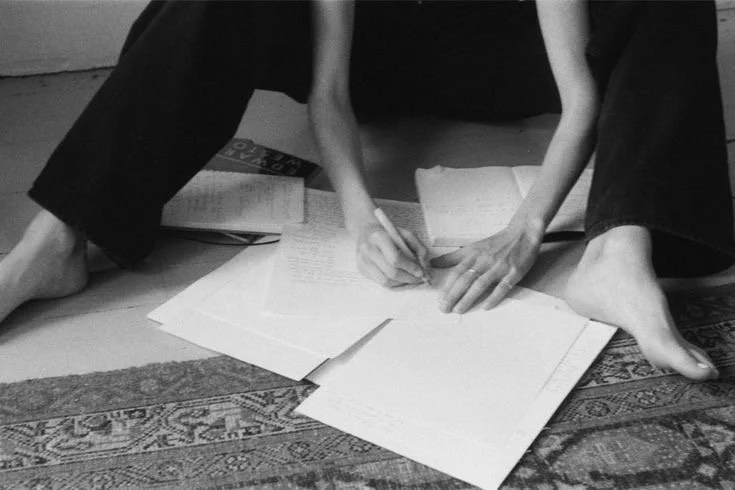
What followed was four years of the most deliberate self-education I have undertaken. I read obsessively — Joe Dispenza on the neuroscience of change, Joseph Murphy on the subconscious as a creative instrument, Neville Goddard on the mechanics of assumption and identity. I moved through Dolores Cannon, through new thought, through the edges of what mainstream science was willing to put in writing. I was drawn to all of it, and I was critical of all of it, in the way that only someone who needs it to actually work tends to be.
What kept returning, across disciplines, across traditions, across the space between quantum physics and depth psychology — was the same core proposition: the self is not fixed. Reality, as we experience it, is not happening to us. It is, in ways both measurable and not yet fully mapped, responsive to the internal structures we carry. Perception. Belief. The nervous system's learned predictions about what the world is. These are not passive. They are generative.
For a woman who had always been drawn to art, to beauty, to what I would call the feminine intelligence embedded in flow and form this should have felt foreign and cold, It didn't. It felt like the most grounded thing I had ever encountered. Here were frameworks. Here was something tangible. Not a set of affirmations to repeat, but actual architecture to understand and work with.
I was not looking for inspiration in a simple sense, I was looking for a mechanism. And the science, once I found my way into it, was exactly that.
ON THE BLUEPRINT
The Blueprint exists at that intersection. It is the accumulation of years of research translated into structured, workable frameworks — drawing from neuroscience, psychology, and quantum physics, and filtered through an aesthetic sensibility that insists the two do not have to be in conflict. Rigour and beauty are not opposites. A well-designed framework is more likely to be used. Knowledge delivered with precision and care is more likely to land.
This journal is where I will think aloud. On the science that underpins the work. On the questions the research keeps returning me to. On what it means to understand the self not as a fixed inheritance but as something that can be deliberately known and deliberately shaped.
That process began, for me, on a plane to Spain with one bag and very little else. It begins, for most people, somewhere far quieter. A moment of looking at the life around them and recognising that something does not fit.
If you are here, you likely know the feeling. The work, as it turns out, is remarkably mappable from there.
As I conclude this I am overwhelmed with such gratitude, writing this has felt like its own kind of return — to a version of myself I don't always slow down enough to visit. I hope my words ignite something in you that is reaching toward the same understanding that has shaped the last four years of my life.
Until Next Time,
With Gratitude
